

Quick Answer: In Texas, defensive driving and deferred disposition are two different paths a court may offer after a traffic ticket, and they do not work the same way. Defensive driving means completing a 6-hour TDLR-approved driving safety course, one course for one ticket, and asking the court to dismiss that ticket. Deferred disposition means the court postpones a final judgment for a probation period it sets, and dismisses the ticket if you meet all its conditions and get no new violation during that period. Which option is better depends on your ticket, your driving record, and what your court allows, so confirm your options with your court before you choose.
Key Facts
- Defensive driving in Texas is a 6-hour course from a TDLR-approved provider, 100 percent online and self-paced.
- One defensive driving course covers one ticket, and Texas drivers may use it for dismissal only once every 12 months.
- Deferred disposition is a court-ordered probation period: the court sets the length, the fee, and the conditions.
- With deferred disposition, the ticket is dismissed only if you complete every condition and receive no new violation during the probation period.
- Our course costs $24.99 one-time: TDLR-approved License #CP2015, 6 hours, 100 percent online and self-paced, free digital certificate within 5 business days, 30-day money-back guarantee.
- The court decides which option is available to you. This post is general information, not legal advice.
How Defensive Driving Works
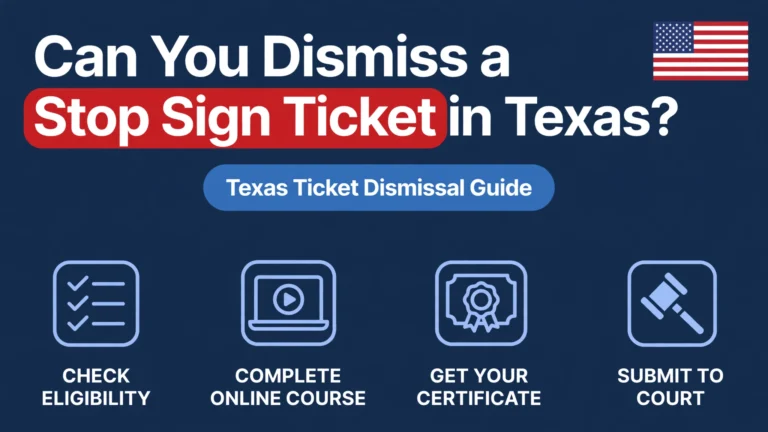
Defensive driving starts with the court’s permission. Before your appearance date, you ask the court for permission to take a driving safety course for dismissal. If the court agrees, you complete the 6-hour TDLR-approved course, then submit your certificate of completion, your Type 3A driving record, and your affidavit to the court before its deadline. When the court accepts all three, it dismisses the ticket.
This path is straightforward, and it has a clear finish line: finish the course, submit the documents, and the dismissal is done. Its main limit is the 12-month rule. If you already used defensive driving for a dismissal within the past 12 months, you generally cannot use it again for a new ticket, and you will need another option or pay the fine. It also covers only one ticket per course, so two tickets need separate handling.
If you want the full step by step process, read our step by step ticket dismissal guide and our defensive driving course overview.
How Deferred Disposition Works
Deferred disposition works differently. Instead of completing a course for immediate dismissal, the court defers its final judgment and places you on probation for a period it chooses. During that period you must follow every condition the court sets, which may include paying a court fee and avoiding any new traffic violation. If you complete the period with no new violation and all conditions met, the court dismisses the ticket.
The advantage is that deferred disposition does not depend on the 12-month defensive driving rule, so it can be an option when defensive driving is not available. The risk is the waiting period: a single new violation during probation can break the agreement, and the court can then enter a conviction on the original ticket. It also usually involves a higher court fee than the $24.99 course price, because the court sets its own fee for deferred disposition.
Side by Side: Which Fits Which Driver?
Choose defensive driving when your court allows it, you have not used it for a dismissal in the past 12 months, and you want the matter closed quickly once you submit your documents. It suits a driver with one ticket who wants a fixed price, a fixed course length, and a clear deadline.
Consider deferred disposition when defensive driving is not available to you, for example because you used it within the past 12 months, or when your court offers it as the better fit for your ticket. It suits a driver who can accept a longer probation period and is confident about avoiding any new violation during that time.
In both cases, do not assume either option is open to you. Eligibility depends on your ticket type, your driving record, and your court’s rules, and some tickets do not qualify for either path. Always ask your court which options apply to your case before you pay for a course or accept a probation agreement.
What to Ask Your Court Before You Decide
Before you choose, ask your court these questions: Am I eligible for defensive driving, deferred disposition, or neither? What is the deadline for each option? What documents must I submit, and by when? For deferred disposition, how long is the probation period, what is the fee, and what conditions apply? Getting these answers in writing, or noting the name of the person who gave them, protects you from guessing about a deadline or a condition later.
Frequently Asked Questions
Q: Can I choose between defensive driving and deferred disposition myself?
A: Not entirely. You can ask for either option, but your court decides what is available for your ticket. Eligibility depends on your ticket type, your driving record, and the court’s rules, so confirm your options with your court before you decide.
Q: Can I use defensive driving if I already used it less than 12 months ago?
A: Generally no. Texas drivers may use defensive driving for ticket dismissal only once every 12 months. If your last dismissal through defensive driving was within that window, ask your court about deferred disposition or another option.
Q: Does deferred disposition cost more than defensive driving?
A: Usually the court fee for deferred disposition is higher than the $24.99 course price, but the exact amount is set by your court, so it varies by case. Ask your court for its fee before you accept deferred disposition, and compare the total cost, not just the course price.
Q: What happens if I get a new ticket during deferred disposition probation?
A: A new violation during the probation period can break the deferred disposition agreement. The court may then enter a conviction on the original ticket. If you receive a second ticket while a dismissal is pending, tell your court about the first case right away and ask how to handle the new ticket.
Ready to Start Your Defensive Driving Course?
If your court has approved defensive driving for your ticket, start your TDLR-approved course today for $24.99 one-time. Six hours, 100 percent online and self-paced, free digital certificate within 5 business days, and a 30-day money-back guarantee. Instant delivery (+$5), a physical copy by mail (+$15), or your Type 3A record (+$24.99) at checkout. Start Your Course
Ready to Dismiss Your Ticket?
$24.99 one-time. 100% online, 6 hours, self-paced. Your free digital certificate arrives within 5 business days.
Sign Up Now: $24.99TDLR Approved, License #CP2015, 30-day money-back guarantee



Leave a Reply