
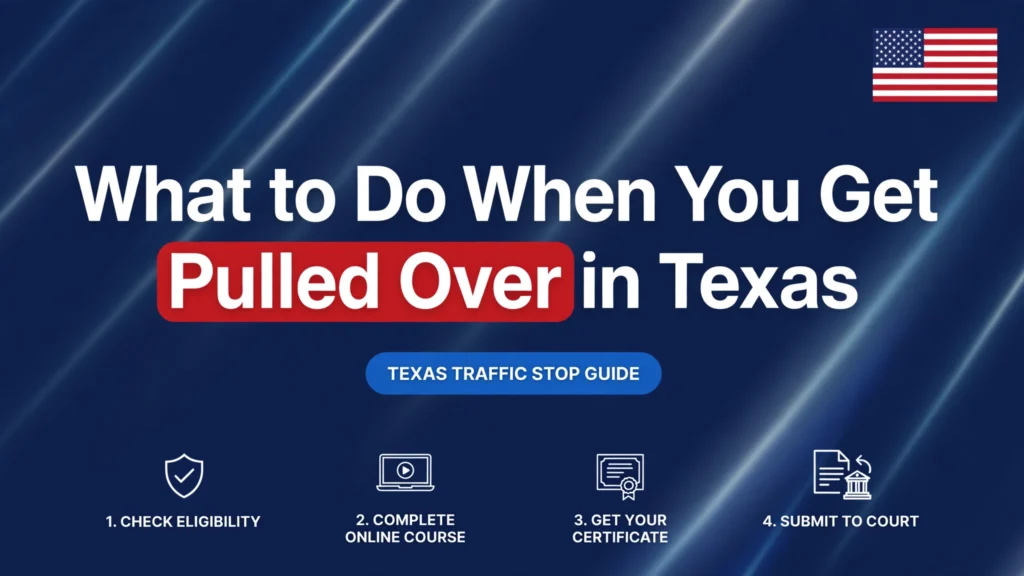
If you get pulled over in Texas, slow down, signal, and pull to the right as soon as it is safe. Turn off the engine, roll down the window, and keep your hands visible on the steering wheel. Stay calm and polite, and hand over your license, registration, and proof of insurance when asked.
Key Facts
- Texas law enforcement agencies conduct millions of traffic stops each year, according to data reported to the Texas Commission on Law Enforcement (TCOLE).
- During a stop in Texas, you must show your driver license, vehicle registration, and proof of insurance when an officer asks for them.
- Never drive away from a stop. Fleeing from an officer in a vehicle is a felony under Texas Penal Code 38.04.
- Most minor tickets, including speeding, can be dismissed with a TDLR-approved defensive driving course once every 12 months, with the court’s permission.
- Our course costs $24.99 one-time: TDLR-approved License #CP2015, 6 hours, 100% online and self-paced, free digital certificate within 5 business days, 30-day money-back guarantee. Instant download +$5, physical certificate by mail +$15, Type 3A driving record +$24.99.
- This post is general information, not legal advice. If you already have a citation, check the court named on your ticket.
What is a traffic stop in Texas?
A traffic stop is when a law enforcement officer signals you to pull over, usually with flashing lights or a siren, because of a suspected traffic violation or a problem with your vehicle. The officer has the authority to stop you, ask for your documents, and issue a citation. A stop is not an arrest, and most stops end with a warning or a ticket. Knowing the steps below keeps the stop short and calm.
What should I do the moment I see flashing lights?
Follow these steps in order:
- Slow down and turn on your signal. Let the officer know you saw them and you are complying.
- Pull to the right as soon as it is safe. Choose a well-lit spot, a parking lot, or a wide shoulder. On a highway, use the right shoulder. Do not stop in a travel lane or on a bridge if you can avoid it.
- Park, turn off the engine, and turn on your hazard lights if it is dark. This tells the officer you are settled and visible.
- Roll down your window and keep your hands on the steering wheel. If it is night, turn on the interior light so the officer can see inside.
- Wait for the officer to speak first. Do not reach for the glove box or your bag before the officer asks for documents. Sudden movements make officers nervous.
What documents do I need to show the officer?
Texas law requires you to show three things when an officer asks:
| Document | Where to keep it |
|---|---|
| Driver license | In your wallet, on your person |
| Vehicle registration | Glove box or center console |
| Proof of insurance | Glove box, or on your phone |
Tell the officer where the document is before you reach for it, for example, “My registration is in the glove box.” Then move slowly.
What should I say, and what should I not say?
Be polite and brief. Answer the officer’s questions about your identity and documents. You do not need to volunteer extra information, and you should not argue about the ticket at the roadside. If you disagree with the citation, the place to fight it is in court, not on the shoulder. Admitting fault on the spot (“I know I was speeding”) can be used against you later, so stick to short, calm answers.
Do I have to agree to a search of my car?
No. In general, an officer needs your consent, a warrant, or probable cause to search your vehicle. You can politely decline a search by saying, “I do not consent to a search.” Stay calm if the officer searches anyway, and do not physically resist. Note what happened and, if needed, raise it with a lawyer or in court later.
Can I record the traffic stop in Texas?
Yes. Texas is a one-party consent state, so you can record your own conversation with the officer. You can also film the stop from your car or phone as long as you do not interfere with the officer’s work. Keep the phone visible and in your hands or mounted, and tell the officer you are recording if they ask what you are doing.
What happens if I get a ticket?
Most Texas traffic stops that end in a citation are for minor moving violations like speeding. You usually have two choices: pay the fine, which puts the ticket on your driving record, or ask the court for permission to take defensive driving and dismiss the ticket. Defensive driving keeps the ticket off your record and can keep your insurance from going up. You can dismiss one ticket every 12 months this way. Learn how ticket dismissal works, or read the full details of our Texas defensive driving course.
Can I refuse to answer questions during a traffic stop in Texas?
You must give the officer your license, registration, and proof of insurance, but you can politely decline to answer other questions. You can say, “I would rather not answer that.” Stay calm and do not argue.
Do I have to get out of the car if the officer asks?
Yes. An officer can lawfully order you, and your passengers, out of the vehicle during a traffic stop. Step out slowly, keep your hands visible, and follow the officer’s instructions.
Can a Texas officer search my car without a warrant?
Usually no. An officer needs your consent, a warrant, or probable cause to search your car. You can politely say, “I do not consent to a search.” Never physically resist a search.
Can I take defensive driving to dismiss a ticket from a traffic stop?
In most cases, yes. Texas courts let eligible drivers dismiss one minor moving violation, including most speeding tickets, with a TDLR-approved defensive driving course once every 12 months. You need the court’s permission before the deadline, then complete the 6-hour course and submit your certificate on time.
Ready to dismiss your ticket? Start your $24.99 Texas defensive driving course today: TDLR-approved License #CP2015, 6 hours, 100% online and self-paced, free digital certificate within 5 business days, and a 30-day money-back guarantee.
Ready to Dismiss Your Ticket?
$24.99 one-time. 100% online, 6 hours, self-paced. Your free digital certificate arrives within 5 business days.
Sign Up Now: $24.99TDLR Approved, License #CP2015, 30-day money-back guarantee

Leave a Reply